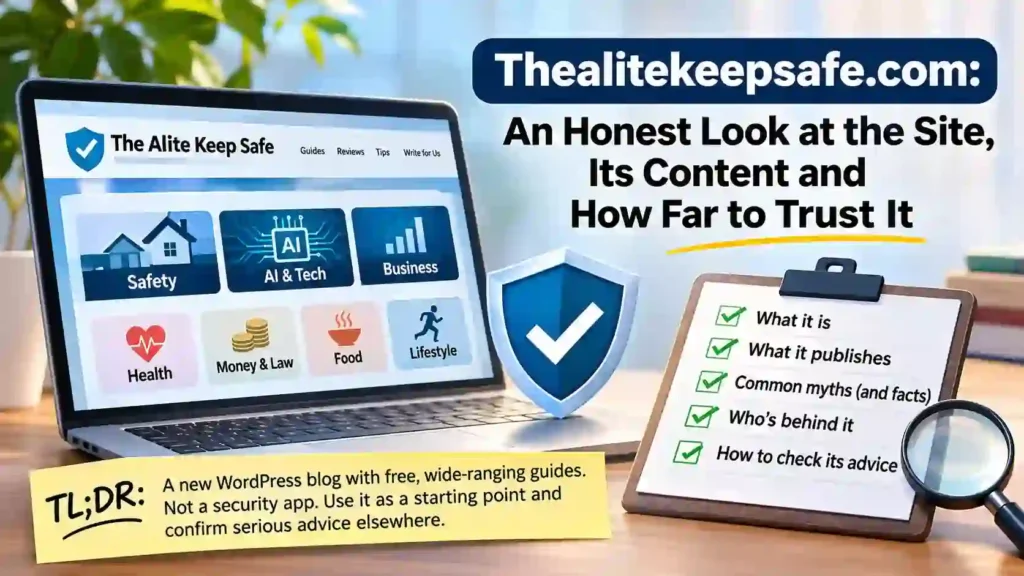
TL;DR: It’s a young WordPress blog, not a security app. Posts began in January 2026 and now span safety, AI, business, food, health, money and more. Pages are free to read, it sells no software, and its owner isn’t named. Treat it as a starting point and confirm serious advice elsewhere.
A name with “keep safe” in it sets an expectation. You picture a vault, a scanner or a privacy shield. Then you open the homepage and find home alarm tips sitting next to soup safety, AI face-swap apps and local SEO.
That mismatch is why so many people search thealitekeepsafe .com and come away confused. This guide covers what the site really is, what it publishes, which popular claims about it are false, how its privacy policy reads, who appears to be behind it, and a practical method for checking any advice it gives before you rely on it.
What Is Thealitekeepsafe .com?
Definition: This is a content-publishing website, branded “The Alite Keep Safe” or “TheAliteKeepSafe.” It posts free guides, explainers, reviews and tips on many everyday subjects. There’s no software, storage, login or protective service behind it.
In its own words, the blog wants to share useful updates in an easy-to-browse format, and its About page leans toward simple guidance on browsing safely, using digital tools and protecting privacy. In practice, that safety theme is just one thread in a much wider publication.
It’s also new. Archive pages run from January 2026 onward, and its privacy policy carries a January 26, 2026 date. So everything on it has been written within the past year or so.
Why does the search term have a space in it?
People often type the name as “thealitekeepsafe .com,” with a gap before the extension. That usually happens when the address is copied from a social post or document that broke it up. Web addresses can’t contain spaces, so the real site is thealitekeepsafe.com, written as one word. Whichever version you search, type the joined-up form into your browser to land on the right page.
What Will You Actually Find on the Site?
The variety is the first thing most visitors notice. The homepage and category menu cover far more than online safety. Here’s a snapshot of what reviewers saw published:
| Topic area | Examples of real article subjects |
|---|---|
| Digital safety | Protecting small-business data, privacy basics, suspicious links |
| Home and personal safety | Upgrading home security systems, stair handrail safety |
| Health and household | Storing medicine safely, food handling and soup safety |
| Technology and AI | AI video and avatar tools, face-swap apps |
| Business and marketing | Local SEO, CRM data protection, remote IT support |
| Money and law | Cryptocurrency, cash in safe-deposit boxes, restaurant fire-code aisles |
| Lifestyle | Sports, entertainment, education and general guides |
Beyond articles, the footer carries the usual housekeeping pages, covering terms, a disclaimer, privacy, contact details and an about section. The navigation has also shown Guides, Reviews and Tips sections, plus a “Write for Us” link.
What the range tells you
A blog that writes about fire codes on Monday and crypto wallets on Tuesday can’t have deep specialist knowledge in every field. That isn’t a criticism, just a reality check. It means each article deserves to be judged on its own evidence, not on the site’s name.
Is It a Security App, Password Manager or Keepsafe?
None of those. This is where existing reviews disagree most, and a few of them describe features that simply aren’t there. Here’s what holds up and what doesn’t:
| Claim found online | What the evidence shows |
|---|---|
| “Sign up and get real-time scam alerts” | No account system or alert service appears on the site |
| “Family safety dashboard and premium plans” | No dashboard, subscription or checkout exists |
| “Encrypted storage like a password manager” | It stores nothing; it’s a blog |
| “Running since 2019 under a US company” | The archive only goes back to January 2026, with no business named |
| “Official app or APK available” | The site lists no app of its own |
| “It’s the Keepsafe photo vault” | That vault belongs to a different, unconnected privacy brand |
| “It publishes safety guides” | True, alongside many unrelated topics |
You may also spot a slogan mentioning “Hi Thealite.” It reads as branding for the publication, not the name of a real security technology.
If you actually need protection, look to sources whose job is security. The US cybersecurity agency CISA publishes free, practical guidance for individuals and small businesses on passwords, phishing and software updates.
Is Thealitekeepsafe.com Safe and Legitimate?
It’s a real, active publication, not a scam storefront or malware trap. Reviewers report an HTTPS connection, working policy pages, a contact email and regular posting. Nothing on the site asks you to pay or install anything.
Being legit and being authoritative aren’t the same thing, though. Here’s a quick scorecard based on what the site shows:
| Trust signal | Status | What it means for you |
|---|---|---|
| Secure HTTPS connection | Present | Your connection is encrypted, not the content verified |
| About and Contact pages | Present | You can reach the publisher |
| Privacy policy and disclaimer | Present | Stated practices are documented |
| Named owner or company | Missing | Accountability is unclear |
| Author bylines | Mixed | Some named writers, some posts credited to “admin” |
| Source links in articles | Inconsistent | Check claims yourself |
| Specialist expertise | Not shown | Verify health, money and legal advice |
The site’s own disclaimer frames every post as general information rather than advice. Take that at face value: useful background, not professional advice.
What Does Its Privacy Policy Say?
Since the site has a safety theme, its privacy practices deserve a look. According to reviewers who read it, the policy dated January 26, 2026 says the site may collect what you send through forms, such as your name, email address and message.
It also describes automatic data collection: IP address, browser details, referral pages and usage information, along with cookies and analytics tools. The policy reportedly states that personal information isn’t sold, though it can pass to vendors that help run the site, analytics firms, or officials when the law demands it. It also says the site isn’t meant for children under 13.
What to make of it
That’s a fairly standard policy for an ad-supported blog. Remember, though, that a policy describes what a publisher says it does, not what an auditor has confirmed. If you only read articles and skip the contact form, you share very little.
Who Runs It, and Does It Publish Sponsored Content?
No legal owner, founder or registered business appears on the site. Articles carry a mix of individual bylines and the generic “admin” label, and a public contact email is listed. A byline tells you who’s credited, but it doesn’t prove ownership or expertise.
On the commercial side, the “Write for Us” link suggests outside contributors can submit work. Several reviewers also spotted the domain in paid link-placement catalogs, where companies buy an article slot that points readers toward their own sites. That’s a common income model for young blogs.
What does that mean for you? Some posts may exist partly to promote another company. US rules expect paid endorsements to be disclosed, and the FTC’s consumer advice pages explain how to spot misleading ads, fake reviews and online scams. If an article pushes one product hard with no downsides mentioned, read it as possible marketing.
How Can You Check Its Advice Before Acting on It?
Because the site covers so many high-stakes topics, the smart move is matching each article to the right official source. Here’s the routine I’d follow:
- Type the address correctly. Use the joined-up domain, not a link from an unknown message.
- Note the topic’s stakes. A sports recap needs no checking; a medicine or money tip does.
- Check the date and byline. Prefer recent posts with a named author over undated “admin” pieces.
- Find the primary source. Look up the rule, product or guidance from the organization that actually sets it.
- Compare the details. If the blog and the official source disagree, follow the official one.
- Skip downloads and forms. You never need to install anything or share passwords to read a blog.
And here’s where to go for the most common topics on the site:
| If the article covers… | Confirm it with… |
|---|---|
| Passwords, phishing, data security | A government cybersecurity agency or the software maker |
| Medicine storage or health | The medicine label, a pharmacist or your doctor |
| Food safety at work | Your local health department’s rules |
| Fire codes or building rules | Your local fire marshal or building office |
| Crypto, investing or banking | Your bank, a licensed adviser or the relevant regulator |
| AI or software tools | The tool’s official website and current terms |
A real-world example
Picture a café owner rearranging tables before a busy holiday season. She finds a post on the site about how wide restaurant aisles need to be, and it gives her a helpful overview of why spacing and exits matter.
Before moving a single chair, she calls her local fire marshal’s office. The required clearance depends on her building, seating count and city code, details a general article can’t know. The blog helped her ask the right question; the official answer kept her compliant.
Who Gets the Most Value From the Site?
It works best for curious beginners who want a quick, readable overview before digging deeper. Someone wondering how two-factor authentication works, or what to look for in a home alarm, will get a friendly starting point.
It’s a weaker fit for anyone making decisions with real consequences. Business owners, investors, patients and anyone following safety regulations should treat its posts as background reading only.
And if you landed here hunting for a privacy app or photo vault, you’re on the wrong site entirely. Download security software only from its developer’s official website or a recognized app store.
Key Takeaways
- It’s a general blog, not a security tool, password manager, app or the Keepsafe vault.
- Publishing began in January 2026, and topics now range from AI to food and finance.
- Claims of alerts, dashboards or premium plans don’t match anything on the actual site.
- Its owner isn’t named, and some content may be contributed or sponsored.
- Match each article to an official source before acting on health, money, legal or security advice.
Frequently Asked Questions
What is thealitekeepsafe .com?
It’s a free informational blog, properly written as thealitekeepsafe.com, branded “The Alite Keep Safe.” It publishes guides and explainers on online safety, AI, business, food, health, finance, home security and lifestyle topics. Despite the protective-sounding name, there’s nothing to download, log into or subscribe to.
Is thealitekeepsafe.com legit or a scam?
It appears to be a legitimate, active blog with HTTPS, policy pages, a contact email and regular posts, and there’s no evidence it’s a scam. Its weakness is transparency: no owner is named, and bylines vary. Use it for background reading, and verify important claims with official sources.
Is there a TheAliteKeepSafe app or alert service?
No. The site doesn’t present an official app, APK, sign-up system, alert service, dashboard or paid plan. Reviews describing those features are describing something that isn’t there. If you find a download claiming to be its official app, avoid installing it.
Is TheAliteKeepSafe connected to the Keepsafe vault?
No. The Keepsafe name belongs to a separate privacy company best known for a photo-vault app. TheAliteKeepSafe is an unrelated blog that happens to share similar words. For a real photo vault, install one from its developer’s official website or a recognized app store.
Can you write a guest post for TheAliteKeepSafe?
Its navigation has shown a “Write for Us” link, and reviewers found the domain on paid article-placement marketplaces. That suggests outside contributions are possible. Writers should contact the site directly to confirm current terms, and readers should keep in mind that some posts may be sponsored.
Conclusion
Look past the reassuring name and thealitekeepsafe .com turns out to be a broad, beginner-friendly blog from 2026 with standard policy pages, no products and no named owner. It’s genuinely handy for a first look at a topic, as long as you confirm anything important with the people who actually set the rules.
A good blog can point you in the right direction. Getting all the way there is still your job.