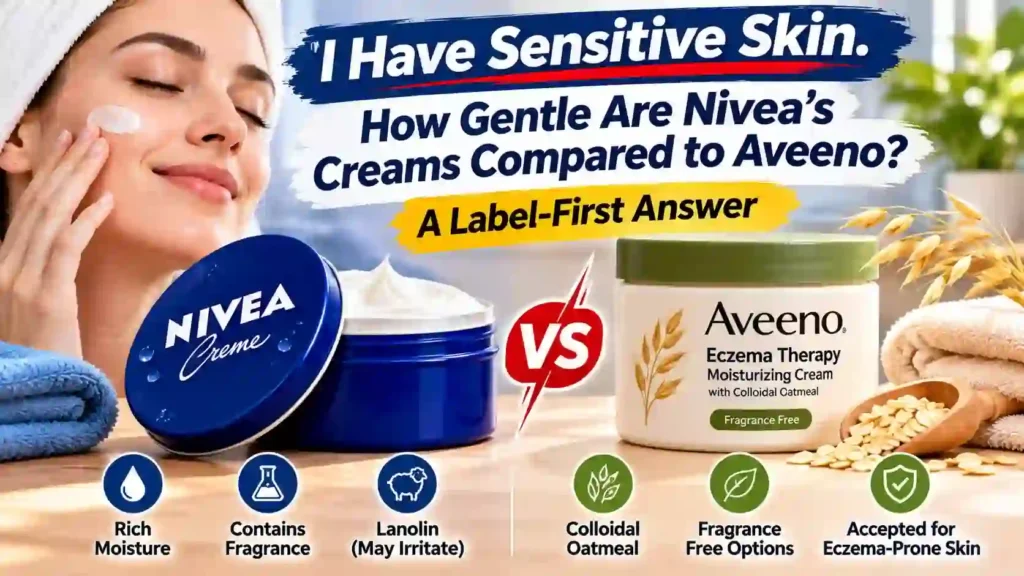
TL;DR: Aveeno usually wins for touchy skin, but only its unscented formulas. The famous blue Nivea tin is scented and uses lanolin alcohol, so it suits dry skin that rarely reacts. Nivea’s unscented Repair & Care cream is its safest bet. Judge the jar, not the logo.
Most people pick a moisturizer the way they pick a toothpaste: whatever their parents bought. That habit works fine until your face starts burning ten minutes after you put cream on.
If you’re asking, “I have sensitive skin. How gentle are Nivea’s creams compared to Aveeno?”, you deserve more than a vague “both are good.” Below, we’ll decode what the labels say, look at where each brand shines and stumbles, match products to real-life skin problems, and walk through a calm, low-risk way to test something new.
What Should You Look for on a Label First?
Definition: A trigger ingredient is any component that’s more likely than average to provoke redness, stinging or itching in reactive skin. Added scent is the best-known example, but it isn’t the only one.
Turn any tub around and the ingredient list tells you more than the front ever will. Words like “gentle,” “mild” or “soothing” aren’t controlled terms, so a brand can print them on almost anything. The ingredient panel is the part that has to be accurate.
When skin is reactive, three things deserve a quick scan:
- Scent words: parfum, fragrance, aroma, or essential oils such as lavender or citrus.
- Declared scent allergens: names like linalool, limonene, geraniol or citronellol, usually near the end.
- Personal red flags: anything you’ve reacted to before, whether that’s wool grease (lanolin), oats or a particular preservative.
Dermatologists repeat one piece of advice more than any other here: if your skin flares easily, go unscented. The American Academy of Dermatology is a good place to read more about caring for skin that’s dry, itchy or easily irritated.
So What’s Inside the Blue Nivea Tin?
Nivea’s classic cream is old-school in the best and worst ways. Its base relies on mineral oil and wax to seal in water, with glycerin to pull moisture into the skin and panthenol for comfort. On chapped knuckles in January, that heavy seal is genuinely useful.
The trouble starts further down the list. The tin includes added perfume, and the label declares a whole cluster of scent compounds, among them linalool, limonene and cinnamyl alcohol. European rules require these to be named because they’re known to cause allergies in some people.
There’s also lanolin alcohol, a fatty substance derived from sheep’s wool. Plenty of people never notice it. A smaller group, though, reacts to lanolin, and for them this cream is a poor match no matter how dry their skin gets.
Is there an unscented Nivea?
Yes. In some countries, Nivea sells a Repair & Care cream and lotion without added scent, pitched at very dry skin that tends toward eczema. Shoppers in the UK and South Africa can find it on Nivea’s local sites. Elsewhere, you may need to hunt, and you shouldn’t assume any other Nivea jar is unscented until you’ve read it.
Why Do So Many Sensitive-Skin Shoppers Reach for Aveeno?
Oats are Aveeno’s whole personality. Across the range, you’ll see oat-based ingredients, and several of the brand’s moisturizers come in a no-scent version. Its everyday body lotion, for example, has an unscented edition that’s thin enough for daily use without feeling greasy.
The product most relevant to reactive skin is the Eczema Therapy cream. Its active ingredient is colloidal oatmeal at 1%, which the label classes as a skin protectant, and it adds ceramide to help the skin hold water. It contains no added scent and no steroids.
That last cream has another useful credential: it’s accepted by the National Eczema Association. To earn that seal, a product has to pass the group’s screening for known irritants, and it must be unscented. It’s one of the few signals on a jar that comes from an outside organization rather than the brand’s own marketing team.
What exactly is colloidal oatmeal?
It’s oat kernels milled into a powder so fine it spreads evenly through a cream or a bath. In the United States, it’s one of the approved ingredients for over-the-counter skin protectants, a category overseen by the US Food and Drug Administration. Products in that category are meant to shield irritated skin and ease minor itch for a while.
Keep two caveats in mind, though. Aveeno sells scented items too, so the oat logo doesn’t promise anything about fragrance. And while oat allergy is uncommon, it does exist.
How Do the Two Brands Compare Side by Side?
Here’s a fresh look at the main candidates, judged purely on what matters to reactive skin:
| Question | Blue Nivea tin | Nivea Repair & Care (unscented) | Aveeno daily lotion (unscented) | Aveeno Eczema Therapy cream |
|---|---|---|---|---|
| Added scent? | Yes | No | No | No |
| Lanolin present? | Yes (lanolin alcohol) | Check local label | Check label | Check label |
| Oat-based? | No | No | Yes | Yes (1% colloidal oatmeal) |
| Outside eczema seal? | No | Not that I found | Not that I found | Yes |
| Feel on skin | Very heavy | Medium to rich | Light | Rich, absorbs fairly well |
Read the table one row at a time and the pattern jumps out. So how gentle are Nivea’s creams compared to Aveeno once scent is out of the picture? Far closer than most people expect. The biggest difference isn’t Nivea versus Aveeno, but scented versus unscented.
Which One Fits Your Kind of Sensitive Skin?
“Sensitive” is a bucket term. It can mean anything from tight cheeks in winter to a full eczema flare. Matching the product to the problem is where most people go wrong.
Your skin is dry but rarely angry
If your main complaint is tightness and flaking, and creams almost never sting, the blue Nivea tin may serve you well. It’s especially handy for hands, heels and elbows. Try it on a small area first if you’ve never used it.
Scents set you off
Choose unscented, full stop. That could be Aveeno’s no-scent lotion for everyday use or Nivea’s Repair & Care if you can find it. Either removes the most common cause of trouble.
You’re dealing with eczema or cracked, raw patches
Go for something richer that’s been screened by an outside group, such as Aveeno’s Eczema Therapy cream. If your eczema is moderate to severe or keeps coming back, it’s worth having a dermatologist involved, since a moisturizer alone may not be enough.
A real-life scenario
Think about a cyclist who rides to work through freezing wind every morning. By February, her cheeks are rough, pink and sting whenever she washes her face. She’s been slathering on her grandmother’s blue tin, and it feels heavy and burns slightly when it goes on.
Her skin isn’t allergic to everything. It’s wind-damaged, and the perfume in the cream is likely irritating already-raw skin. Switching to an unscented, oat-based cream at night and a light unscented lotion before her ride would give her skin the protection without the sting.
What About Feel, Cost and Daily Convenience?
How they feel
The blue tin leaves a noticeable coating, almost like a balm. That’s protective outdoors but can feel suffocating on an oily T-zone. Aveeno’s lotions sink in faster, while its eczema cream sits between the two.
What you’ll pay
Neither brand is a luxury label, and both are sold in most pharmacies and supermarkets. Prices swing a lot between countries and container sizes, so here’s a simple habit: divide the price by the volume. A cheap-looking small jar can work out pricier than a big pump bottle.
Ease of use
Pump bottles are quicker for whole-body moisturizing after a shower. Tubs and tins are better for targeted spots like knuckles and heels. Many people end up keeping one of each.
Where Does Each Brand Fall Short?
Neither brand is perfect, and it helps to see the weak points plainly.
Nivea’s weak spots for reactive skin
- Its best-known cream is perfumed and declares several scent allergens.
- Lanolin alcohol can be a problem for the minority who react to it.
- The unscented alternative is harder to find in some regions.
Aveeno’s weak spots for reactive skin
- Some of its products are scented, so the oat branding can mislead.
- People with oat allergies need to steer clear.
- There’s no ultra-thick, balm-like option to rival the blue tin’s heaviness.
Where each brand is strong
- Nivea: an excellent water-sealing texture for very dry, non-reactive skin.
- Aveeno: a wider choice of unscented formulas, including one with an independent eczema seal.
How Can You Try a New Cream Without a Flare?
Here’s the low-drama approach I’d recommend for anyone with reactive skin:
- Pick one product only. If you change several things at once and react, you won’t know which caused it.
- Choose a test spot. The soft skin inside your elbow or below your ear is ideal.
- Use a small dab twice a day. Keep going for about a week, because some reactions are slow to show.
- Look and feel daily. Pinkness, itch, little bumps or a hot feeling mean you stop.
- Graduate to a small facial patch. Try a coin-sized area on your jaw for a few more days.
- Then go all in. Only use it across your whole face once both tests stay calm.
A bonus tip: snap a quick phone photo of your test spot each day. Slow changes are easy to miss, and a photo makes them obvious.
If reactions keep happening no matter what you try, see a dermatologist. Formal patch testing can name the exact substances your skin objects to.
Key Takeaways
- Scent matters more than brand, so unscented formulas from either company are the safer start.
- The blue Nivea tin suits dry, non-reactive skin but is perfumed and contains lanolin alcohol.
- Aveeno’s unscented lines tend to treat touchy skin better.
- Aveeno Eczema Therapy cream carries an outside eczema seal and uses colloidal oatmeal.
- Test one product at a time for roughly seven days before it goes on your whole face.
Frequently Asked Questions
How gentle are Nivea’s creams compared to Aveeno?
It comes down to the specific jar. Nivea’s classic tin is perfumed and contains lanolin alcohol, so it’s less gentle on reactive skin. Aveeno’s unscented products are usually the kinder option, especially its Eczema Therapy cream. Nivea’s unscented Repair & Care cream narrows the difference where it’s available.
Which is better for eczema, Nivea or Aveeno?
For eczema-prone skin, Aveeno’s Eczema Therapy cream has the edge. Its 1% colloidal oatmeal is listed as the active protectant, it includes ceramide, has no added scent and is accepted by the National Eczema Association. Nivea’s unscented Repair & Care range is also aimed at eczema-prone dryness, but availability varies.
Does Aveeno have fragrance in it?
Some Aveeno products do and some don’t. Several moisturizers, including its everyday lotion and Eczema Therapy cream, come in versions with no added scent. Others in the range are scented. Check for “fragrance free” on the packaging and scan the ingredient list before buying if you react easily.
Why does Nivea cream sting my face?
A sting usually means your skin barrier is damaged or that an ingredient is irritating it. The classic Nivea tin contains perfume and declared scent allergens, which can bother raw or sensitive skin. If it stings, stop using it, switch to an unscented moisturizer and see a dermatologist if irritation continues.
Is colloidal oatmeal safe for sensitive skin?
For most people, yes. Colloidal oatmeal is an approved over-the-counter skin protectant ingredient in the US, used to help shield irritated skin and ease minor itching. A small number of people are allergic to oats, though, so patch test a new oat product for several days before using it widely.
Conclusion
How gentle are Nivea’s creams compared to Aveeno when your skin is sensitive? The label tells the real story. Aveeno’s unscented formulas usually come out ahead, while the blue Nivea tin is best kept for skin that’s dry but rarely reactive.
Familiar packaging feels safe, but your skin only responds to what’s inside. Read first, test second, and moisturize with confidence.