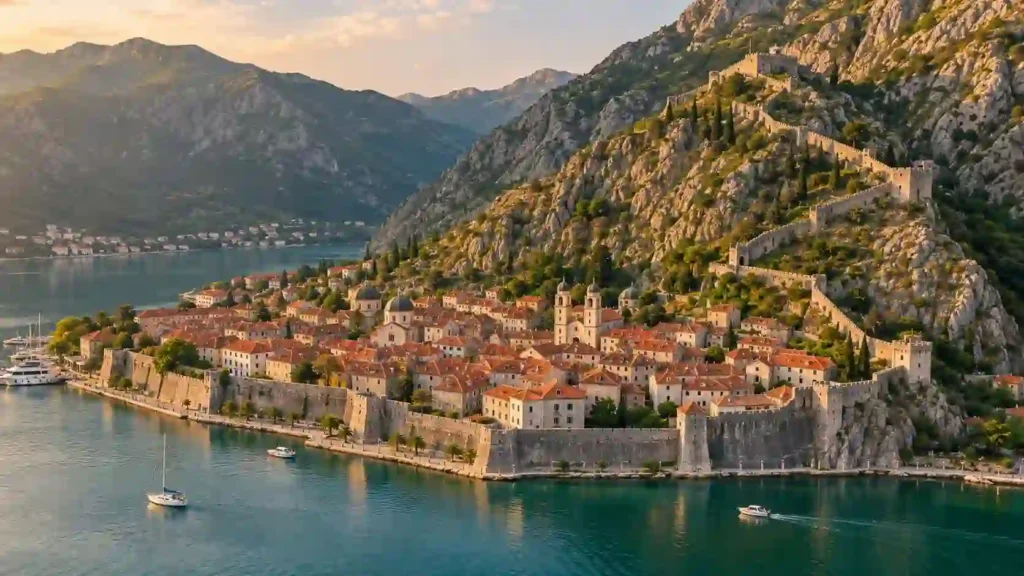
TL;DR: The phrase is everyday Latvian. Melnkalne names the country of Montenegro, while Kotora is how Latvian spells the town of Kotor. Together they name one real place: a walled Adriatic town on the Bay of Kotor, protected by UNESCO since 1979 and famous for its fortress climb, cathedral and mountain-framed bay.
Some phrases look mysterious only because they’re in a language you don’t read. This is one of them. Plenty of websites have spun it into a poetic riddle, but a Latvian speaker would recognize it instantly as an everyday place name.
So what is kotora melnkalne, really? This guide explains the Latvian grammar behind it, corrects the most common myths, and then turns to the destination itself: where Kotor sits, why UNESCO protects it, what to see first, when to go, how to get there and whether to search or book using the Latvian name.
What Does Kotora Melnkalne Mean?
Definition: “Kotora, Melnkalne” is how a Latvian writer would label “Kotor, Montenegro.” Melnkalne is the country’s accepted name in Latvian, and Kotora adapts the town’s name to Latvian spelling. It refers to one real town, not a separate or hidden destination.
Latvian doesn’t simply borrow “Montenegro.” It translates the idea. The country’s local name, Crna Gora, and its Italian-based name both mean “black mountain,” and Latvian builds the same meaning from melns (black) and kalns (mountain). International place-name databases such as GeoNames’ list of names for Montenegro record Melnkalne as the Latvian form.
Neighboring languages do the same thing in their own way. Lithuanian uses Juodkalnija and Latgalian uses Malnkalneja, both built on “black mountain.” Seen in that company, the Latvian version looks completely ordinary.
Why the endings keep changing
Latvian nouns change their endings depending on their role in a sentence. That’s why you’ll spot slightly different spellings on Latvian travel sites:
| Latvian form | Grammatical role | Rough English equivalent |
|---|---|---|
| Kotora | Basic form | Kotor |
| Kotoras | Possessive | of Kotor (as in “Kotor’s port” or “the Bay of Kotor”) |
| Melnkalne | Basic form | Montenegro |
| Melnkalnes | Possessive | of Montenegro (as in “Montenegro’s coast”) |
| Melnkalnē | Location | in Montenegro |
| Melnkalnei | Direction or recipient | to or for Montenegro |
Latvian ferry pages, for example, describe the port of “Kotoras” at the end of “Kotoras līcis,” the Bay of Kotor, on “Melnkalnes” Adriatic coast. Once you know these endings, Latvian search results become far easier to read.
Why Do So Many Pages Get the Name Wrong?
Because the phrase is unfamiliar to English readers, many articles guess at its origin instead of checking. Several describe it as a creative coinage, a mood or a symbolic identity. Others even present the town like a celebrity with a “career” and “personal life.”
Here’s how the common claims compare with the evidence:
| Claim found online | What’s actually true |
|---|---|
| “A lyrical label dreamed up by bloggers” | It’s a normal Latvian place name |
| “Melnkalne merely sounds like Baltic words for a dark peak” | It’s the country’s actual name in Latvian |
| “It isn’t recognized anywhere official” | Place-name databases and Latvian travel sites use it routinely |
| “It’s a different town from Kotor” | It names the same town |
| “Residents use the Latvian phrase” | Residents say Kotor; the Latvian version exists for Latvian readers |
Some researchers also point to Latvia’s national library, whose geographic-name records reportedly list the form “Kotora (Melnkalne)” alongside Kotor, Montenegro. Either way, the conclusion is the same: there’s no mystery to solve, only a translation to understand.
Where Is Kotor, and What Is Its Bay Like?
The town occupies the innermost tip of Boka Kotorska, the Bay of Kotor, in Montenegro’s southwest corner. The limestone massif of Mount Lovćen rises steeply behind the town to 1,749 metres, so the walls, rooftops and water sit squeezed into a narrow strip of land.
The bay itself is bigger and more complex than photos suggest. Figures published by the Municipality of Kotor give a sense of its scale:
| Bay of Kotor fact | Figure from municipal data |
|---|---|
| Total surface area | 87.3 km² |
| Maximum depth | 60 m |
| Average depth | 27.3 m |
| Length of coastline | 105.7 km |
| Sailing route from the bay entrance to Kotor | 33 km |
It’s often nicknamed Europe’s southernmost fjord, but that label isn’t geologically precise. Fjords are carved by glaciers, while this winding inlet is generally described as a submerged river system, or ria. The practical result is the same: calm, sheltered water and mountains that seem to rise straight out of it.
Why Does UNESCO Protect Kotor and Its Bay?
UNESCO doesn’t protect only the Old Town. The listing, officially the Natural and Culturo-Historical Region of Kotor, covers the town, its fortifications and the surrounding inner bay, including settlements such as Perast and the islets of St. George and Our Lady of the Rocks. Full details of the property are published by the UNESCO World Heritage Centre.
The timing of its inscription is unusual. A severe earthquake hit the coast on April 15, 1979, leaving Kotor badly damaged. Later that same year, the site was added to the World Heritage List and placed straight onto the List of World Heritage in Danger. After major restoration work, it was removed from the danger list in 2003.
The walls tell the town’s story
Venice ruled Kotor between 1420 and 1797, and much of its defensive system dates from that long period. The outer walls run for about 4.5 kilometres, are up to 20 metres high and range from 2 to 16 metres thick. Earthquakes in 1563, 1667 and 1979 all damaged them, and each time they were repaired.
The fortifications later gained a second layer of recognition. In 2017, Kotor’s defenses were included in a UNESCO listing covering Venetian defensive works across the Adriatic, which is why you’ll sometimes hear Kotor called a double World Heritage site.
What Should You See First in Kotor?
The Old Town is compact enough to cross in minutes, yet it rewards hours of slow wandering. Here’s an easy way to sequence a first visit:
- Start at the Sea Gate. This waterfront entrance leads into the Square of Arms, a natural starting point for exploring.
- Visit St. Tryphon’s Cathedral. Consecrated in 1166, this Romanesque cathedral was badly damaged in 1979 and blessed again in 2000 after years of restoration.
- Find the smaller churches. St. Luke’s and St. Nicholas’s sit close together and reflect the town’s mixed Catholic and Orthodox heritage.
- Climb toward San Giovanni Fortress. The stepped path follows the walls up roughly 1,350 steps to about 260 metres above sea level.
- Learn the seafaring story. The Maritime Museum explains how ships and sailors shaped the bay’s wealth.
- Take a boat from Perast. The tiny islet church of Our Lady of the Rocks is a short ride from Perast’s waterfront.
A correction worth knowing
You may read that the fortress stands 1,200 metres above sea level. It doesn’t. It sits at roughly 260 metres, which is still a serious climb in summer heat. The Church of Our Lady of Remedy, about halfway up, makes a natural rest stop and turnaround point if you don’t want to reach the top.
My tip for the climb
Go at first light. The path faces the sun and has very little shade, and the steps fill quickly once cruise passengers arrive. Wear shoes with real grip, carry water and leave extra time for the descent, which tests your knees more than the climb tests your lungs. Check current ticket arrangements before you start, as access to the upper section isn’t always free.
When Should You Go, and How Long Should You Stay?
Each season gives Kotor a different personality. This overview shows the general pattern:
| Season | Conditions | Ideal for |
|---|---|---|
| Spring | Mild weather, green slopes, moderate crowds | Walking the walls, sightseeing, photos |
| Summer | Hot days, busiest streets, long evenings | Sea swims, bay cruises, festivals |
| Early autumn | Warm sea, thinner crowds | A balance of beach and sightseeing |
| Winter | Quiet, cooler and wetter, some services reduced | Calm streets and lower prices |
Most first-time visitors find two or three nights about right. That gives you one day for the Old Town and fortress, another for Perast and the bay, and breathing room for weather or rest.
A simple two-day plan
Spend day one inside the walls: the cathedral in the morning, a long lunch, then the fortress climb in the cooler late afternoon or the next dawn. On day two, head to Perast, ride across to Our Lady of the Rocks and return to Kotor for an evening walk once the day crowds have gone.
How Do You Get There and Get Around?
The nearest air link is Tivat Airport, only a short drive from the Old Town. Many travelers also compare flights into Podgorica, or into Dubrovnik across the border in Croatia, then continue by road. Ferry routes link Montenegro’s coast with Italy and Croatia too, which suits anyone traveling with a car.
Once you arrive, walk. Cars aren’t allowed inside the Old Town, and its lanes are best explored on foot. Buses, taxis and organized boat trips cover Perast and other bay towns, while a rental car mainly helps if you’re heading inland toward Lovćen or along the wider coast.
A few practical points help the trip run smoothly. Montenegro uses the euro, stone streets get slippery when wet and cruise-ship schedules strongly affect daytime crowds. Before you book, check Montenegro’s current entry rules for your passport through your government’s official travel advice.
Should You Search and Book Using the Latvian Name?
Use both names, each for a different job. The Latvian phrase helps you find content written for Latvian speakers, while the English name unlocks the full range of international bookings.
- Research in Latvian. Queries such as “Kotora, Melnkalne” or “ceļojums uz Melnkalni” tend to bring up Latvian agencies, traveler reviews and blogs.
- Book in English. Hotels, flights, ferries and maps outside Latvia list the town as Kotor.
- Double-check tickets. Confirm the arrival point shows Kotor or the right harbor before you pay.
- Read Latvian endings correctly. Kotoras and Melnkalnē are the same places, just in different grammatical forms.
A real-world example
Imagine a retired teacher from Daugavpils planning her first Adriatic trip. Searching in Latvian, she finds a Latvian blog about “Kotoras vecpilsēta,” the Old Town, plus a package from a Riga travel agency. She compares that package with booking her own flights and a guesthouse under “Kotor, Montenegro.”
The Latvian sources give her trustworthy tips in her own language, while the English search shows her more accommodation choices and prices. She ends up booking independently, climbs halfway to Our Lady of Remedy at sunrise and spends a slow afternoon in Perast. Knowing both names made every step easier.
Key Takeaways
- It’s simply how Latvian names Kotor, Montenegro, with no hidden destination behind it.
- Melnkalne translates as “black mountain,” matching both Montenegro and Crna Gora.
- UNESCO protects the whole inner bay region, not only the Old Town, and has since 1979.
- The fortress sits about 260 metres up, reached by roughly 1,350 steps along Venetian-era walls.
- Research in Latvian, book in English, and plan two or three nights for a relaxed first visit.
Frequently Asked Questions
What does kotora melnkalne mean in English?
In English, it reads as “Kotor, Montenegro.” Latvian translates Montenegro as Melnkalne, from melns (“black”) and kalns (“mountain”), and writes the town’s name as Kotora. The phrase therefore names the walled Adriatic town English speakers call Kotor, at the far end of its famous bay.
Why do Latvian sites write Kotoras or Melnkalnē?
Latvian nouns change their endings depending on how they’re used in a sentence. Kotoras is the possessive form, as in “the Bay of Kotor,” while Melnkalnē means “in Montenegro” and Melnkalnei means “to Montenegro.” They all refer to the same town and country, just in different grammatical roles.
How high is Kotor Fortress?
The fortress of San Giovanni, or St. John, stands at roughly 260 metres above sea level. Reaching it takes about 1,350 steps along the old defensive walls. Claims that it sits 1,200 metres high are wrong. The Church of Our Lady of Remedy, roughly halfway up, offers a good resting point.
Is all of the Bay of Kotor protected by UNESCO?
Not the entire bay, but much more than the Old Town. The Natural and Culturo-Historical Region of Kotor covers the town, its fortifications and the surrounding inner bay landscape, including Perast and its islets. It was inscribed in 1979 and stayed on the in-danger list until 2003 because of earthquake damage.
How many days do you need in Kotor?
Two or three nights suit most first-time visitors. That covers a day inside the walls plus the fortress climb, and another for Perast, Our Lady of the Rocks and a boat trip on the bay. Extra days let you explore Lovćen, the wider coast or simply slow down.
Conclusion
Strip away the myths and kotora melnkalne turns out to be a clear, ordinary Latvian name for Kotor, Montenegro. Behind it stands one of the Adriatic’s most remarkable towns: Venetian walls climbing a mountainside, a cathedral nearly nine centuries old and a protected bay that rewards anyone who takes time to explore it.
Learning the name takes a minute. Seeing the place properly is worth a few unhurried days.