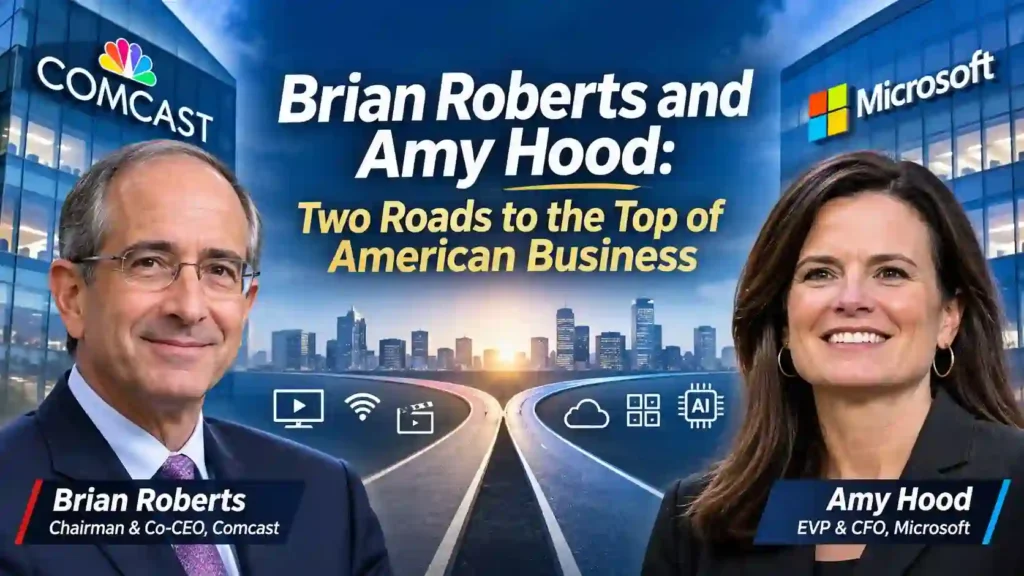
Type two famous names into Google and you expect clear answers. Instead, searches for Brian Roberts and Amy Hood return recycled guesses about marriages, partnerships and secret ties. That noise wastes your time and hides the real story. Here is the fix: a fact-checked look at how a cable heir built a media empire, how a Goldman banker became Microsoft’s money chief, and the 1997 handshake that once tied their companies together.
Quick Answer: Who Are Brian Roberts and Amy Hood?
Brian Roberts and Amy Hood are two of the most influential executives in the United States, but they work for different companies. Roberts runs Comcast as Chairman and Co-CEO. Hood runs every dollar at Microsoft as Executive Vice President and Chief Financial Officer.
The 30-second version:
- Roberts took charge of a mid-sized cable company and turned it into a media and broadband powerhouse.
- Hood rose from Microsoft’s investor relations desk to the finance chair in just over ten years.
- They share no family tie and no known working partnership.
- Their companies crossed paths in 1997, when Microsoft put $1 billion into Comcast.
Why Do People Search for Brian Roberts and Amy Hood Together?
Most people land on this topic after seeing both names in the same news cycle. Comcast and Microsoft both sit at the center of how people watch, work and connect online. Stories about streaming, cloud computing and AI spending often mention both firms.
There is also a historical reason. The 1997 Microsoft investment in Comcast still appears in business histories, and readers sometimes mix up the companies with the people who lead them today.
So the honest answer is simple. The search pairing comes from overlapping industries and one old deal, not from a personal story.
How Did a Cable Founder’s Son Become Comcast’s Boss?
Brian Roberts grew up inside the cable business. His father, Ralph J. Roberts, started the company that became Comcast in 1963, with a single small cable system in Mississippi.
Brian earned his degree from the Wharton School at the University of Pennsylvania in 1981 and walked straight into the family firm. He spent the 1980s learning operations before taking the president’s title in 1990.
His climb to full control came in stages:
- 1990: Named president of Comcast
- 2002: Becomes chief executive officer
- 2004: Adds the chairman’s title
- 2025: Begins sharing the CEO role with Mike Cavanagh
Roberts also holds special Class B shares that give him about one-third of the company’s voting power. That structure lets him think long term without worrying much about short-term activist pressure.
Away from the office, he was a nationally ranked squash player and competed for the United States at the Maccabiah Games several times. He lives in Philadelphia with his wife, Aileen.
Which Bets Turned Comcast Into a Giant?
When Roberts took over as president, Comcast earned well under $1 billion a year. In 2025, it brought in more than $123 billion. That growth did not happen slowly. It came from a handful of huge, risky moves.
The Roberts playbook, deal by deal:
- 2002 — AT&T Broadband. Comcast swallowed AT&T’s cable unit and became the biggest cable operator in America overnight.
- 2004 — A failed run at Disney. Roberts made an unsolicited bid for Disney. It failed, but it showed how big he wanted to go.
- 2011 to 2013 — NBCUniversal. Comcast bought control from GE, then the rest of the company, adding NBC, Universal Pictures and theme parks.
- 2014 to 2015 — Time Warner Cable. Regulators pushed back, and Comcast walked away from the merger.
- 2018 — Sky. Comcast outbid 21st Century Fox at a public auction to win Europe’s top pay-TV brand.
- 2020 — Peacock. Comcast launched its own streaming service. It reached 44 million paid subscribers by the end of 2025.
- 2026 — Versant. On January 2, Comcast spun off cable channels such as USA, CNBC and MSNBC into a separate public company.
Look closely and you’ll spot a pattern. Roberts keeps buying the pipes, the shows and the customer relationships, then sells off what no longer fits.
How Did Amy Hood Go From Wall Street to Microsoft’s Top Finance Job?
Amy Hood took a very different route. She studied economics at Duke University and later earned an MBA from Harvard.
Her first big career stop was Goldman Sachs, where she worked in investment banking and capital markets. In December 2002, she left Wall Street for Redmond and joined Microsoft’s investor relations team.
From there, she moved quickly:
- Early years: Chief of staff in the Server and Tools group
- 2006 to 2009: Leads strategy and business development for the Microsoft Business Division, home of Office
- 2010: Becomes finance chief of that division, which earned about $24.1 billion a year
- 2011 to 2012: Works on the Skype and Yammer purchases
- May 8, 2013: Named CFO of all of Microsoft at age 41
She was the first woman ever to hold Microsoft’s top finance job. Then-CEO Steve Ballmer credited her with helping move Office from boxed software to the Office 365 subscription model.
What Decisions Define Amy Hood’s Time as CFO?
A CFO rarely gets headlines. Hood is an exception because Microsoft’s biggest bets all ran through her office.
Moments that shaped her tenure:
- Backing the cloud shift. She has served alongside Satya Nadella since he became CEO in 2014, funding the push into Azure and subscription software.
- Paying for giant acquisitions. LinkedIn closed in 2016 and Activision Blizzard in 2023, both on her watch.
- Hitting the brakes on AI spending. In late 2024, she questioned internal demand forecasts and helped slow some data center projects.
- Then pressing the gas again. In April 2026, she guided investors to roughly $190 billion in capital spending for calendar 2026.
The results speak loudly. Microsoft’s yearly revenue more than tripled during her time as CFO, reaching $281.7 billion in fiscal 2025.
Outside Microsoft, Hood sits on the board of 3M. In May 2026, she gave the commencement speech at Duke and received an honorary doctorate.
Is There Any Family or Personal Tie Between Them?
No. Public records, company biographies and SEC filings show no family link between Brian Roberts and Amy Hood. They are not married, not siblings and not business partners.
Roberts’ official Comcast biography makes no mention of Hood. Microsoft’s announcement of Hood’s appointment makes no mention of Roberts.
If you read a claim that they are related, check where it comes from. A trustworthy claim points to a filing, a company page or a named news report. A rumor points to nothing.
Which 1997 Deal Brought Comcast and Microsoft Together?
This is the true link, and it happened before Hood ever worked at Microsoft.
On June 9, 1997, Microsoft announced a $1 billion cash investment in Comcast, then the fourth-largest cable operator in the country. Bill Gates ran Microsoft. A much younger Brian Roberts was Comcast’s president.
What the deal included:
- About 24.6 million shares of Comcast Class A Special stock for $500 million, at $20.29 each
- A second $500 million in new convertible preferred stock
- A potential ownership stake of up to roughly 11.5 percent
- A promise that Gates and Roberts would work closely on Comcast’s technology plans
- A board observer seat for Microsoft executive Greg Maffei
Gates wanted fast data pipes into homes so PCs and TVs could work together. Roberts wanted money and tech know-how to build high-speed internet over cable. Investors cheered, and cable stocks rallied for years afterward.
The partnership faded over time. Comcast replaced Microsoft’s TV guide software with its own in 2007, and Microsoft sold off its Comcast shares around 2008 and 2009.
Where Hood fits in: nowhere in this deal. She joined Microsoft five years later.
Brian Roberts and Amy Hood Compared Side by Side
| What We Compared | Brian L. Roberts | Amy Hood |
|---|---|---|
| Employer | Comcast (Philadelphia) | Microsoft (Redmond) |
| Title today | Chairman and Co-CEO | Executive VP and Chief Financial Officer |
| How they got in | Joined the family company in 1981 | Hired from Goldman Sachs in 2002 |
| Years to reach the top job | 21 years to CEO | About 11 years to CFO |
| Schooling | Wharton, University of Pennsylvania | Duke (economics), Harvard (MBA) |
| Source of power | Founder’s family, Class B voting shares | Control of budgets, deals and forecasts |
| Signature moves | AT&T Broadband, NBCUniversal, Sky, Peacock | Cloud funding, LinkedIn, Activision Blizzard, AI spending |
| Biggest miss or pause | Failed Disney bid, dropped Time Warner Cable deal | Slowed data center build-out in late 2024 |
| Outside role | Business Roundtable member | 3M board member |
| Fun fact | Competitive squash player | First woman to serve as Microsoft CFO |
Owner vs. Steward: Two Ways to Hold Power
Roberts leads like an owner. His family’s voting shares mean he answers to the long arc of Comcast, not the next earnings call. That freedom lets him chase deals that would scare most CEOs.
Hood leads like a steward. She doesn’t own Microsoft, but she guards its money. Her power comes from saying yes or no to billions in spending, and from earning the trust of investors every quarter.
Brian Roberts and Amy Hood prove that both styles work. One builds by adding. The other builds by choosing wisely what to fund and what to stop.
Five Lessons You Can Use in Your Own Business
You don’t run a Fortune 500 company? These ideas still apply to a startup, an agency or a side hustle.
- Learn the ground floor first. Roberts studied his family’s business for years before he ran it. Know every part of your own operation.
- Own the relationship with your customer. Comcast’s biggest asset is its direct link to tens of millions of homes. Your client list works the same way.
- Doubt your rosiest forecast. Hood questioned Microsoft’s own projections before spending more. Test your numbers before you scale.
- Be ready to walk away. Roberts dropped the Time Warner Cable merger when the cost got too high. A bad deal costs more than no deal.
- Play a long game. Both leaders have stayed in their companies for over two decades. Mastery takes time.
What Comes Next for Comcast and Microsoft in 2026 and Beyond?
Comcast enters the next stretch leaner. With cable channels moved into Versant, it can focus on broadband, wireless, Peacock, live sports and theme parks. Its wireless arm added 1.5 million lines in 2025, its best year ever.
Microsoft is racing to meet demand for AI. It reported $82.9 billion in revenue for the quarter ending March 31, 2026, up 18 percent from a year earlier. Hood’s challenge now is to keep that growth paying for record spending on data centers.
Brian Roberts and Amy Hood will keep shaping how millions of people stream, work and connect. Watching their next moves tells you a lot about where media and tech are heading.
Your Move
The story behind Brian Roberts and Amy Hood is not a mystery or a romance. It’s a lesson in two different ways to build lasting power: one through bold ownership, the other through careful stewardship.
Now you have the facts, the timeline and the one deal that really links their companies. Use them. Share this guide with anyone who still believes the rumors, and keep it bookmarked for the next time these two names trend together.